← back to naxatar
Available Chrome, Edge & Firefox · YouTube

Playlist Wrangler

A free extension for Chrome, Edge, and Firefox that organizes any YouTube playlist — search it, auto-tag it, split it, export it. No API keys, no OAuth, no paid tier, and your index lives in your browser, not on a server.

Read the docs Free · v1.21.0 · all three stores

Playlist Wrangler can

  • Search and filter videos across all your playlists
  • Automatically categorize every video — topic, genre, mood, language
  • Add your own categories on top of the automatic ones
  • Bulk add, move, remove, and re-categorize — with one-tap undo
  • Split and merge playlists
  • Sort by length, views, likes, or age — or shuffle
  • Play any filtered set from any row, or your selection in the order you picked it
  • Queue videos onto YouTube’s real queue — Play next or Add to queue, one row or a whole selection
  • Know which videos are songs YouTube Music will play, filter to them, and play them there
  • Save to any playlist straight from a thumbnail
  • Import pasted YouTube links or video IDs into a playlist
  • Export any view to CSV
  • Ask what’s in a video without playing it, and keep the answers (beta)
  • Auto-sync scanned playlists with YouTube
  • Read private and unlisted playlists, Watch Later, and Liked videos
  • Keep the row of any video YouTube deletes, privates, or blocks
  • Warn before a playlist hits YouTube’s 5,000-video cap, and free up room in one click
  • Tell Shorts from videos, and filter either out
  • Show the like-to-view ratio on every video, right in YouTube
  • Work across multiple signed-in YouTube accounts
  • Scan every video in detail (optional) for YouTube’s own category, keywords, and exact stats
  • Teach you its shortcuts at the moment they’d help — and never twice
  • Run with no API keys, no OAuth, and no quotas
  • Keep the whole index locally in your browser
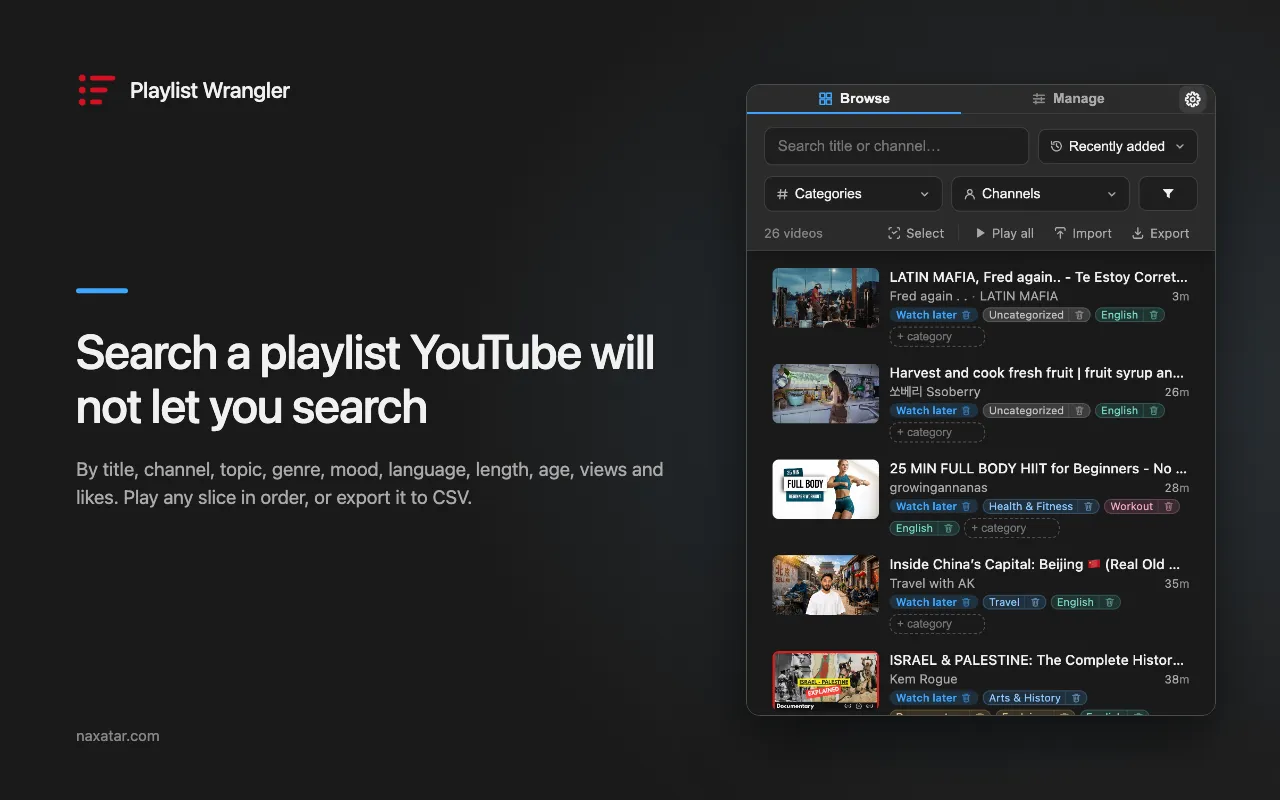
The side panel searching a playlist by title, channel, category and length, next to the headline “Search a playlist YouTube will not let you search.”
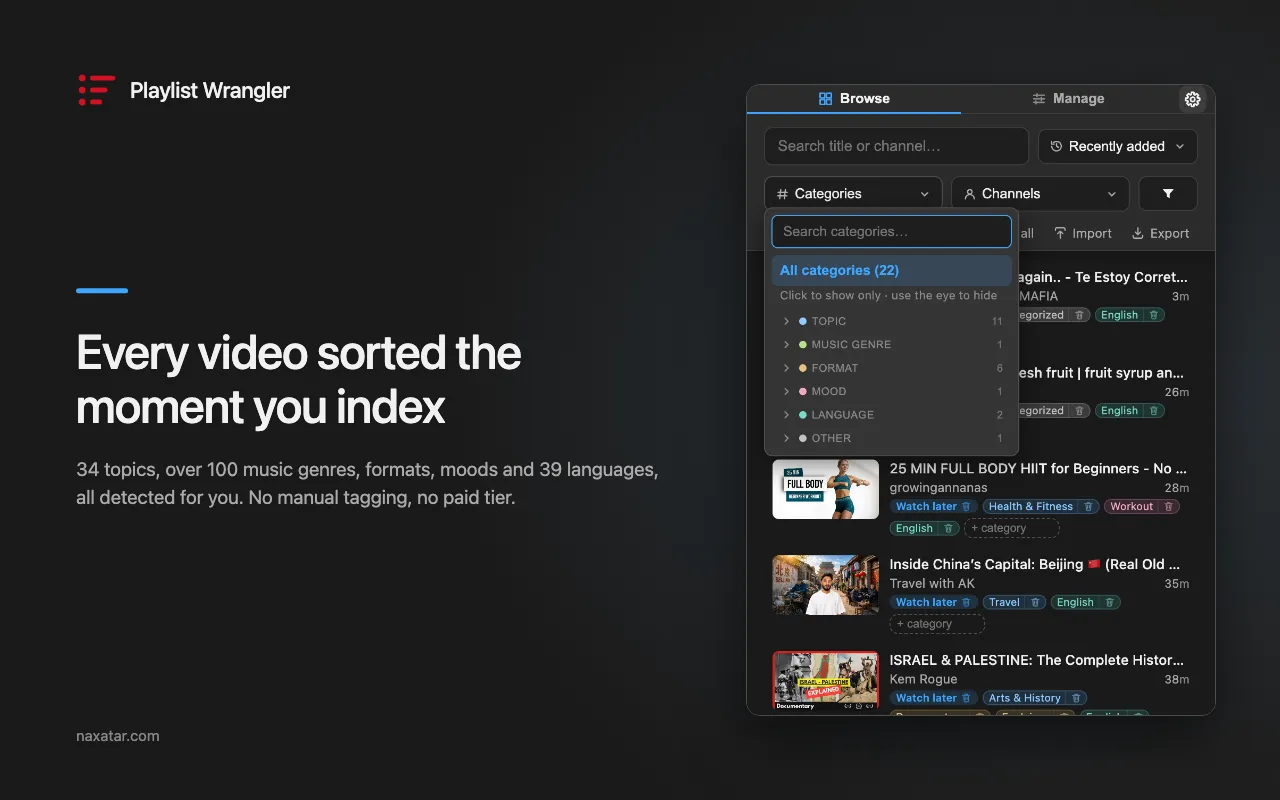
The category filter open, grouped into topic, music genre, format, mood and language, next to the headline “Every video sorted the moment you index.”
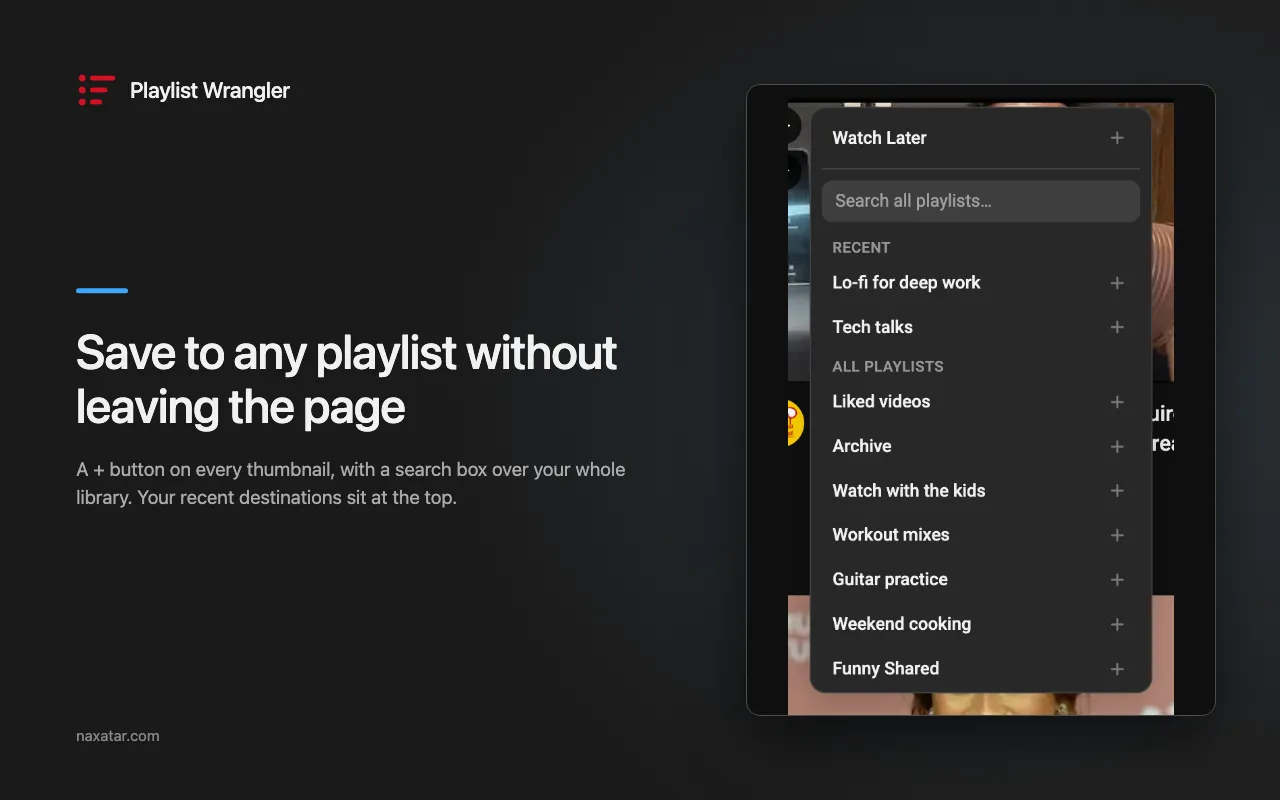
The Quick Add menu on a YouTube thumbnail, searching every playlist, next to the headline “Save to any playlist without leaving the page.”
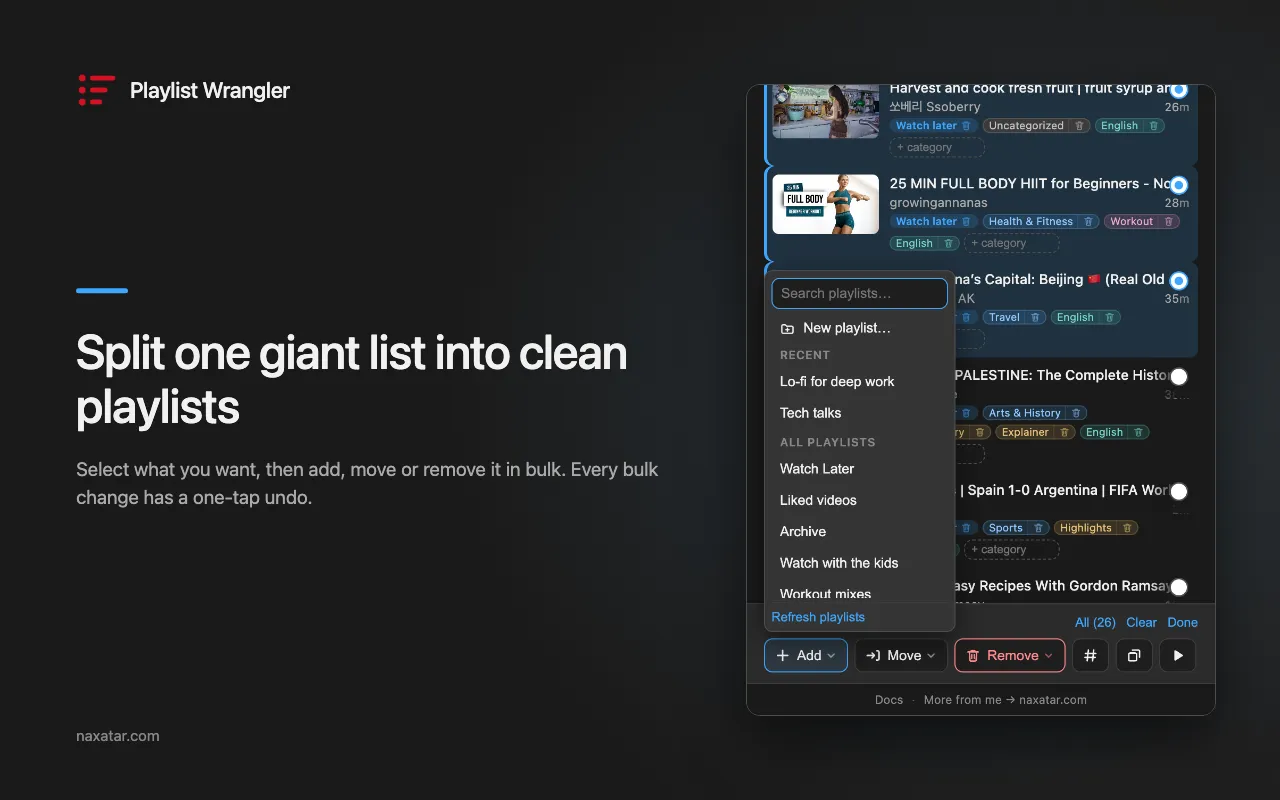
Several videos selected with the bulk add, move and remove bar, next to the headline “Split one giant list into clean playlists.”
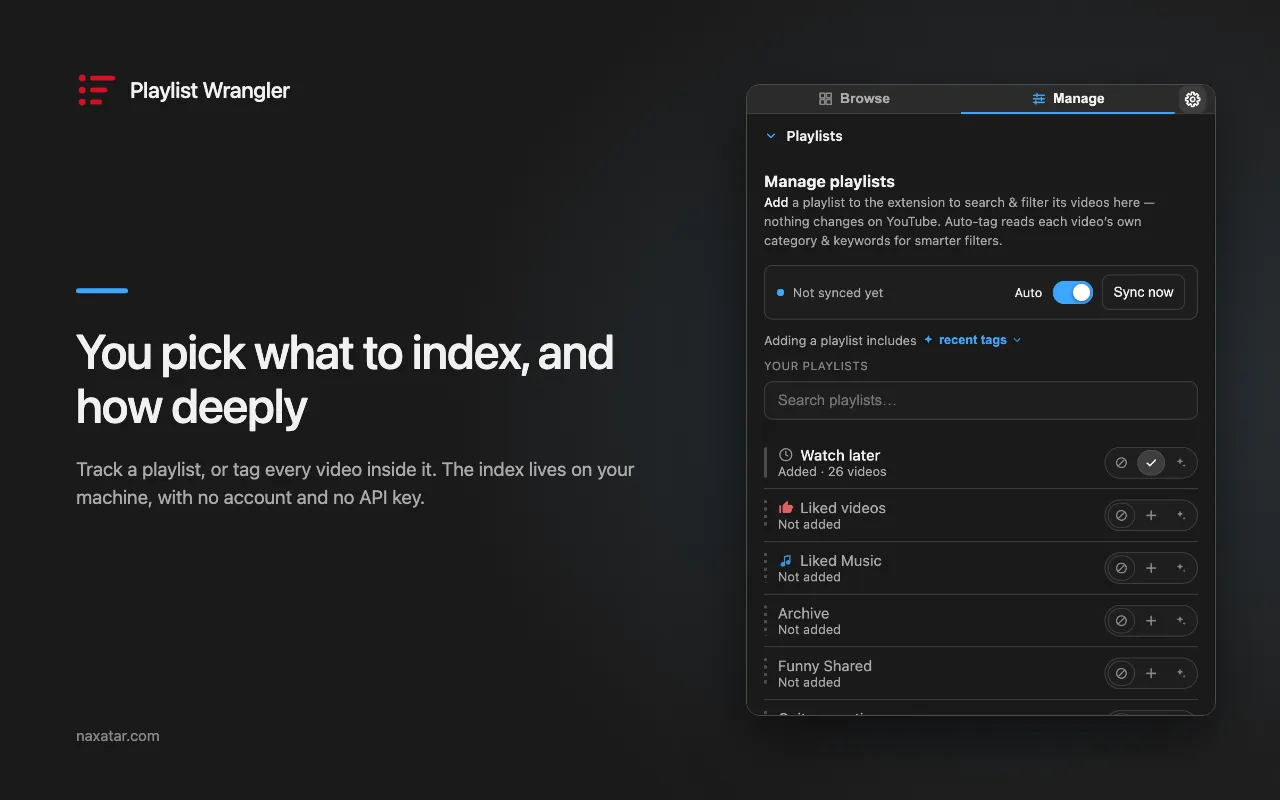
The Manage tab listing playlists to index or skip, next to the headline “You pick what to index, and how deeply.”

Scroll for more →

New in v1.21.0
  • The panel knows which of your videos YouTube Music will play, asked of YouTube Music itself rather than guessed from a title. Each song wears a small music note; click it to show only songs, or pick On YT Music / Not on YT Music under More filters.
  • Play on YT Music, when you mean to. A song’s playback menu gains “Play on YT Music” and “Play from here on YT Music”, and with songs selected a YT Music button sits beside Play. Everything else plays on YouTube as before.
  • Play in the result bar now shows only with a selection. “Play all” is gone: the whole list has always played from any row’s “Play from here”, and one way to do it is enough.

YouTube hands you a playlist, not a way to search it. Past a hundred videos it barely lets you scroll, and the official API means keys, OAuth, and quotas. Playlist Wrangler skips all of that, makes the list findable, and lets you reshape it into playlists you actually use.

See it in action
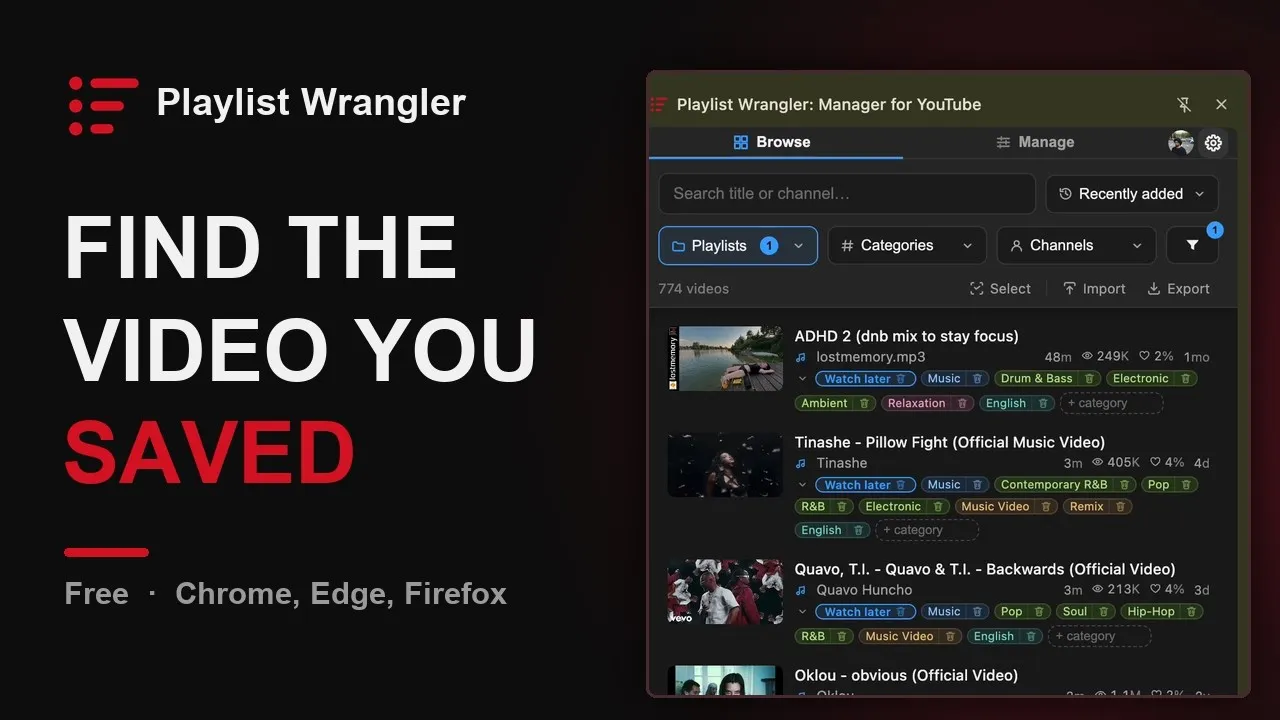
What it does

Search and filter that works

Full-text search across every video, plus filters for category, channel, length, language, age, views, likes, and captions. Each filter leads with the values still present in what you’re looking at.
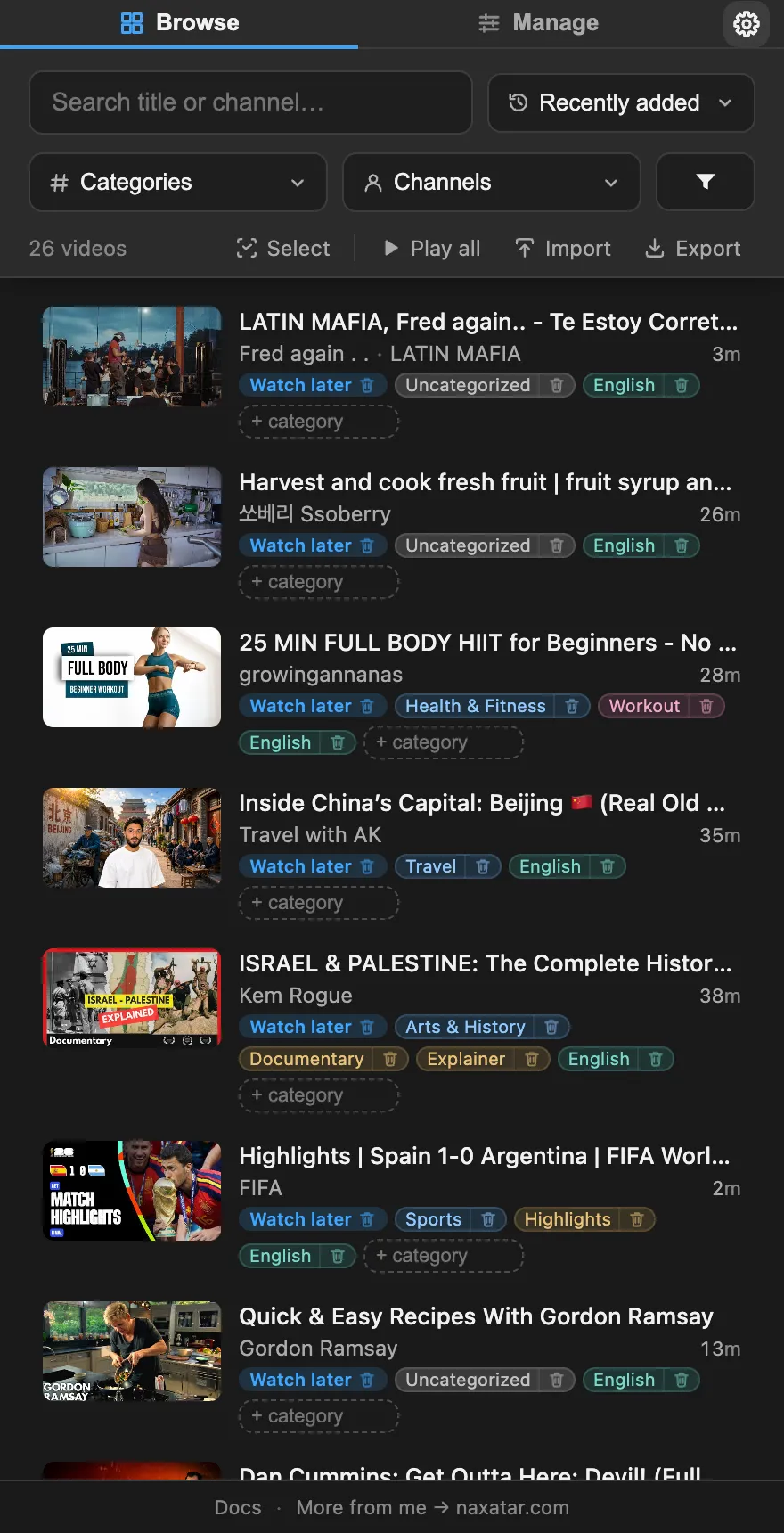
The side panel listing a playlist’s videos, each with its category, language, channel and length, above a search box and filter row.

Sorts every video for you, free

The moment a playlist is indexed, every video is sorted across 34 topics, over 100 music genres, film and TV genres, formats, moods, and 39 languages. No labeling, and not a paid upgrade.
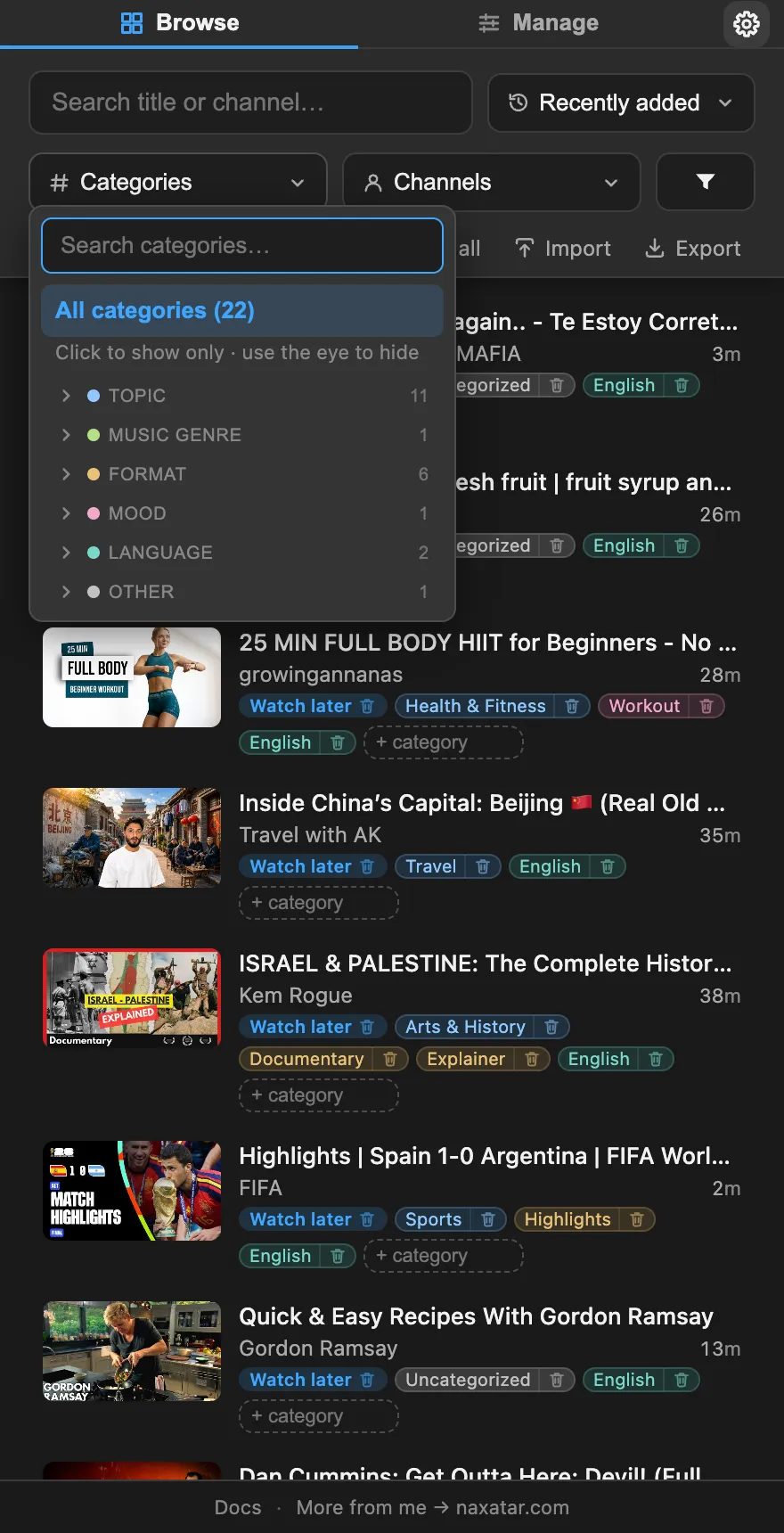
The category filter open, its groups labelled topic, music genre, format, mood and language, with counts beside each.

Save to any playlist, without leaving the page

A + button on any thumbnail reaches your whole library through a search box, with recent destinations on top. A ✓ marks what you already have, and clicking it takes the video back out.
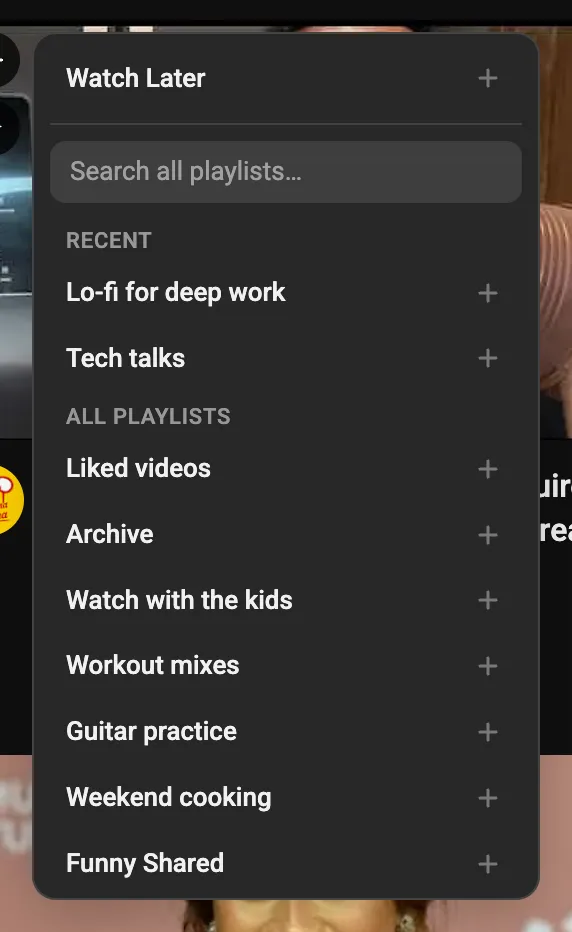
The Quick Add menu open over a YouTube thumbnail, with a search box across every playlist and recent destinations listed first.

Split one list into many

Filter to what belongs together, select the lot, and move it into its own playlist in one step. Every bulk add, remove, or move has a one-tap undo.
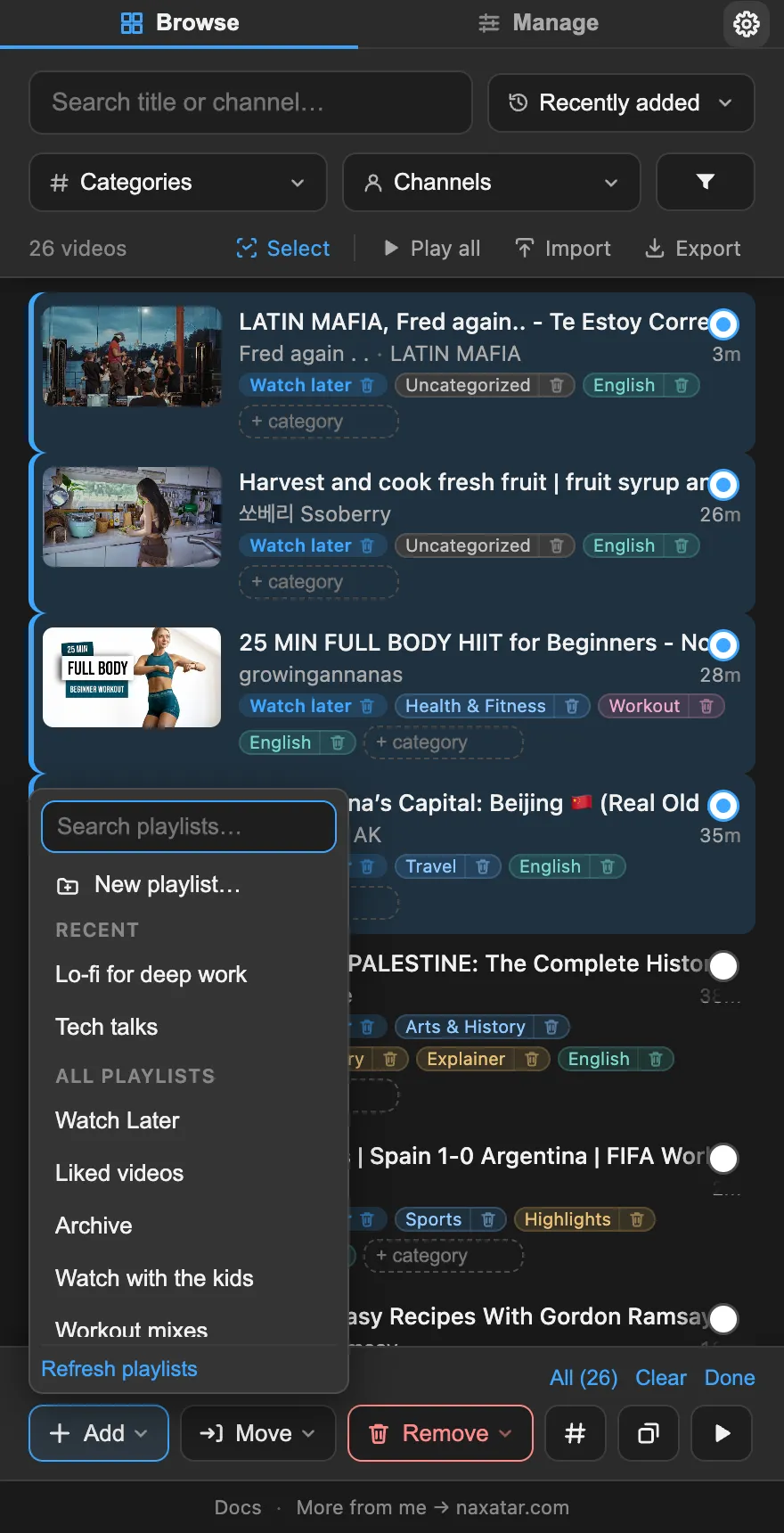
Several videos selected in the panel, with an add, move and remove bar along the bottom.

Build tonight’s queue by hand

Cmd-click (Ctrl on Windows) the videos you want, in the order you want them, and press Play. Each one wears its place in the running order as you pick it, and they play in exactly that order as a temporary playlist. Or push them onto YouTube’s real queue, after whatever is already playing.

Your library outlives YouTube’s limits

A video YouTube deletes or privates keeps its row, with the title you would otherwise never see again. A playlist near the 5,000-video cap reads as a fraction of it, with a one-click way to free up room. Liked videos past 5,000 are kept instead of dropped. And any view exports to CSV.

No API, no OAuth, no quotas

It reads the playlist from the page you’re already on, riding your own signed-in session. Nothing to authorize.

Works everywhere you do

Private and unlisted playlists, Watch Later, and Liked videos. It reads the whole list, past YouTube’s ~100-video first page, and knows which entries are Shorts.

Onto YouTube’s real queue

Play next or Add to queue from any row, or Queue a whole selection, into the YouTube tab you already have open, after whatever is playing.

Your songs, on YouTube Music

The panel asks YouTube Music which of your videos it will play, marks each with a music note, and filters to only songs. Play one there, or the songs on screen from any row, in the order shown.

See how a video landed before you open it

The like-to-view percentage sits inline in YouTube’s own byline, and every panel row carries likes, views, length, and age.

Bring videos in, and take your library out

Paste a list of video links and Import adds them all to the playlist you pick, skipping duplicates and handing back any it can’t. Any view exports to CSV, unavailable and overflowed videos included.

Ask what’s in a video without playing it

Quick Ask summarizes from the thumbnail using YouTube’s own Ask AI, with every mode one click away on the answer and a week of answers kept to reread. In beta, and only on accounts YouTube has given Ask.

Scan every video in detail, if you want

A throttled, resumable pass that pulls YouTube’s own category, the uploader’s keywords, and full stats to sharpen the categories. Every scan already does this for the newest 100.

One home for every playlist

A side panel spanning every playlist you’ve scanned, with the same video across lists merged into one row. A window of its own in Opera and Arc.

How it works

  1. 01

    Open a playlist

    On any YouTube playlist page, hit the floating button and choose “Scan this playlist.”

  2. 02

    It reads the whole list

    The extension pages through the playlist as your own signed-in session — past YouTube’s ~100-video first page — sorts every video into categories, and stores it all on your machine.

  3. 03

    Search, filter, organize

    Search, stack filters, add your own categories. Pick a few videos and play them in that order, or move a batch into its own playlist. Saved locally for next time.

  4. 04

    Go deeper (optional)

    Scan every video in detail to add YouTube’s own category, the uploader’s keywords, and full stats, which sharpens the filters.

Everything stays in your browser.

On your machine

The index lives in your browser’s local storage. Your playlists, tags, and metadata never leave your device.

No account, no sign-in

No API keys and nothing to log into. The only thing it sends is anonymous, content-free usage counts.

Only the edits you ask for

It adds, removes, and moves videos when you say so, with undo. It never likes, subscribes, or comments.

Honest about limits

Titles first, detail on request

Descriptions and transcripts aren’t part of basic playlist data, so a scan reads each video’s title and channel, and opens only the newest 100 for more. Scanning every video in detail adds YouTube’s own category, keywords, and exact stats to the rest.

Automatic categories are guesses

They’re worked out on your machine from what a video says about itself, so some will be off. Every one can be changed or removed, in bulk if you like, and anything you set by hand is never overwritten.

YouTube moves, and I follow

It reads YouTube’s live page rather than a stable API, so a big redesign can occasionally call for an update. The parser is built defensively to ride most of them out.

Questions

Can it organize a huge Watch Later?
That’s the case it was built for. Watch Later is scanned like any other playlist, then you can search it, filter it down to what belongs together, and move that selection into its own playlist — so one 3,000-video pile becomes playlists you’d actually open. Bulk add, move, and remove each have a one-tap undo. And because Watch Later stops at 5,000 videos, the panel warns you as it fills, offers to free up room by moving the oldest 500 out in one step, and exports any view to CSV. Bulk actions in the docs →
What happens when a YouTube playlist hits the 5,000-video limit?
YouTube stops the playlist at 5,000 and never tells you: the save button flashes “Saved” and the video is dropped. Playlist Wrangler shows the count as a fraction once a playlist passes 90% — “4,812 / 5,000” — and every Add and Move menu says how many still fit, or marks the playlist Full and won’t let you pick it. A “Free up room” link opens the playlist with its oldest 500 videos already selected, so moving them into another playlist is the next click. Liked videos behaves differently: liking keeps working past 5,000 but YouTube lists only the latest 5,000, so the panel keeps every like that falls off, marked Overflow. The 5,000 cap in the docs →
A video in my playlist was deleted — can I find out what it was?
If you scanned the playlist before it disappeared, yes. When a video is deleted, made private or blocked, YouTube hides it and the playlist page just says “Unavailable videos are hidden.” The panel notices on its next full read and keeps the row, dimmed and marked Unavailable, with the title, channel and thumbnail from your last scan. You can filter to those rows, export them to CSV, and remove them; they can’t be played. It can’t recover a video it never saw, so scanning early is what makes this work. Unavailable videos in the docs →
Can it filter Shorts out of a playlist?
Yes. A Short in a playlist looks exactly like a video — same row, same link, same thumbnail — and length is no guide, since Shorts run to three minutes. So the extension asks YouTube rather than guessing, and “More filters” opens with a Videos | Shorts choice. A playlist that has quietly filled with Shorts can be seen for what it is, or set aside, and playlists made entirely of Shorts scan properly too.
Can I filter a playlist by genre, mood, or language?
Yes, and you don’t have to label anything first. Scanning sorts every video across 34 topics, over 100 music genres, film and TV genres, formats, moods, and 39 languages, all worked out locally on your machine. Each of those is a filter you can stack with channel, length, views, likes, age, and captions, and you can add categories of your own on top.
Is there a free extension that automatically tags or categorizes a YouTube playlist?
Yes. Playlist Wrangler categorizes every video the moment you scan a playlist — across 34 topics, over 100 music genres, formats, moods, and 39 languages — with no manual tagging and no setup. The automatic categorizing is part of the free extension, not locked behind a paid tier or upgrade. You can search, filter, and split your playlists by those categories right away, and add your own on top.
Can I export a YouTube playlist to CSV or Excel?
Yes. “Export CSV” downloads exactly the list in front of you — filters and sort order included — with title, channel, video ID, URL, duration, views, published date, and categories in the columns. It’s UTF-8 with a BOM, so Excel opens it cleanly. It’s the practical answer to YouTube’s 5,000-video cap: a list you spent years building becomes a file you keep. Export details →
Can it summarize a YouTube video without playing it?
Quick Ask does, in beta. From a thumbnail or the watch page, ask about a video and the answer appears beside it — a short summary by default, with Key Points, Chapters (timestamps you can click to jump the player) and any modes you write yourself one click away across the top of the answer. Answers stay open until you close them, and the past week of them can be reread from the Manage tab. It runs on YouTube’s own built-in Ask AI, so there is nothing extra to sign into, and it only works on accounts YouTube has given that feature.
Can I sort or shuffle a playlist by length, views, or likes?
Yes — newest or oldest, longest or shortest, most liked, best likes-per-view, or a random shuffle, over whatever your filters have left. Pick “Play from here” on any row and the list plays through in that order with autoplay, as a temporary playlist, so there is nothing to build or clean up afterwards.
Can it find the songs in my playlists and play them on YouTube Music?
Yes. The panel asks YouTube Music itself which of your videos it will play, rather than guessing from a title or channel, and fills that in with each scan and sync. Each song carries a small music note on its row; click it to show only songs, remembered across opens, or pick On YT Music / Not on YT Music under More filters. A song’s playback menu offers “Play on YT Music” for that song and “Play from here on YT Music” for the songs on screen from that row, in the order shown, and with songs selected a YT Music button sits beside Play. A video nobody has asked about yet is in neither bucket, so nothing is filed as not music by default, and a line under the count says how many are still being checked. YouTube Music in the docs →
Can I add videos to YouTube’s queue from the panel?
Yes. The play button on any row’s thumbnail opens a small menu with Play from here, Play next, and Add to queue; the last two write into the real queue of the YouTube tab you have open, the same one YouTube’s own “Add to queue” fills, so you can stack videos onto whatever is already playing. Select several and a Queue button appears beside Play that adds them all, in the order you picked them, and reports exactly how many landed. Queueing in the docs →
What is the like-to-view percentage it shows?
How well a video landed, before you spend time on it. The like-to-view percentage sits inline in YouTube’s own byline right after the view count, on the watch page, the home feed, and search results — and every row in the panel carries likes, views, that ratio, length, and age, so you can sort or cut a huge list by what people actually liked.
Do I need a YouTube or Google API key?
No. There’s no API, no OAuth, and no quota. It reads the playlist from the page you’re viewing, using your own signed-in session.
Does it work on private or unlisted playlists?
Yes. As long as you’re signed in and can see the playlist, the extension can scan it.
Where is my data stored?
In your browser’s local storage, on your machine. Your playlists and categories never leave your device. The only thing it sends is anonymous, content-free usage counts, and there’s no account to create.
Can it change anything on my YouTube account?
Only your playlists, and only when you ask. You can add, remove, and move videos between playlists from inside the extension. It never likes, subscribes, comments, or changes anything else.
Is it free?
Yes. It’s completely free and ad-free, including the automatic tagging — there’s no paid tier that unlocks extra features. If it helps you, you can support the work, but you never have to.
How is it different from PocketTube?
They solve different problems. PocketTube organizes the channels you subscribe to — groups, a filtered feed, notifications. Playlist Wrangler organizes the videos inside your playlists — search, automatic tagging, splitting, export. Many users would sensibly run both. Read the full comparison →
My old playlist extension stopped working. Does this replace it?
Probably, yes. Several popular playlist and Watch Later extensions have gone a year or more without a release and no longer keep up with YouTube’s page changes. Selecting videos in bulk, moving and copying them between playlists, removing duplicates, sorting and bulk-clearing are all here, and there is nothing to set up first. Which ones still work →
Which browsers does it work on?
Chrome, Microsoft Edge, and Firefox each have their own listing, and the Chrome build installs in Brave, Opera, and Arc as well. It’s a Manifest V3 extension, and every listing is built from the same source, so the features match. Opera and Arc have no side panel for extensions, so there the panel opens as a window of its own — see below.
Is there a Firefox version?
Yes, on Firefox Add-ons, built from the same source as the Chrome extension. It runs in Firefox’s sidebar instead of Chrome’s side panel, and every feature is the same, including automatic tagging, Quick Add, and export. If you browse YouTube inside a Multi-Account Container, it uses the session belonging to that tab, so the right account is the one it works with. Get it for Firefox →
Is there a Microsoft Edge version?
Yes, on the Edge Add-ons store, from the same source as the Chrome extension. It uses Edge’s own side panel, and every feature is the same. You could also install the Chrome listing in Edge, but the Edge listing updates through Edge itself, so it’s the one to use. Get it for Edge →
Does it work in Arc?
Yes, since 1.17.0, as a window rather than a side panel, and it is experimental. Arc and Opera are the two Chromium browsers without Chrome’s side panel API for extensions, so there the panel opens as a window of its own beside your browser window. The library, search and playlist edits work from that window; Play and Add to queue use the YouTube tab you have open. In Opera the keyboard shortcut toggles the window; Arc does not deliver extension shortcuts, so use the toolbar icon there. If something does not behave as it does in Chrome, the feedback link in the panel reaches me.

Looking for how-to steps on a specific feature? The searchable docs cover every one.

Found a bug or have an idea?

It goes straight to the maker — one person who builds Playlist Wrangler. No account, no thread to chase.

Type

Goes straight to the maker. No playlist data is sent.

Organize any YouTube playlist.

Free, private, and it stays out of your way. Pick your browser.

Free and ad-free. If it helps you, you can support the work.